|
|
||

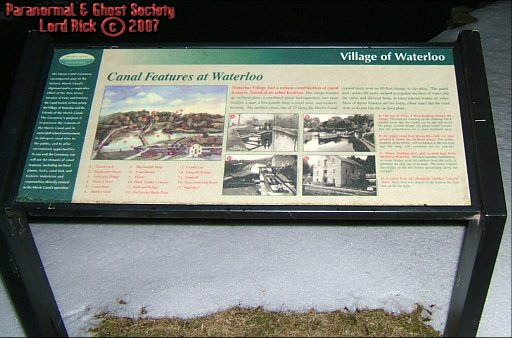
Waterloo is supposed to be one of the biggest most well preserved ghost towns in Northern New Jersey this is why I chose it cause it had an amazing history to it. They actually call it Waterloo Village and despite what Adam says this is the right location. At first we passed by it and Adam told me that this place is not it so he told me to drive about 4 miles down the road which we did and I pulled down a dark road in the woods. He showed me quite a few abandoned houses many of them did not look very old and I thought to myself wait....Waterloo Village is from the early 1800s so this definitely was not the place. I refused to stop because there was many newly developed houses near the abandoned ones so I drove all the way back down the road and there it was the old village of Waterloo with its big white church, cemetery, mill and old wood houses. Unfortunately that is the problem when your a founder of an organization people refuse to listen to you they think because they live somewhere they know or seen all their is to see and that just is it as the founder I can pull strings and find out just about anything about any given location. But this place is very historic hence why I chose it and further below you will understand why I made it so attentive to visit here before we started heading all the way down to the Pine Barrens. Waterloo dates back to a time when the Lenape Indians roamed the area and made use of the rich natural resources off the landscape and waterways. The village of the Lenape Indians was started in Waterloo over 400 years ago and was the port site of the Morris Canal. Their was an island called Winakung on Waterloo lake that had long houses, huts, women's quarters, burial grounds, carvings and artifacts. The indians inhabited this island in the 1600s. When the Indian village began to fade a discovery of rich veins of iron were discovered and the Andover Forge was established here making bar iron for the shipment to England before the American Revolution. Waterloo Village was what it was a canal town and was around the half way point along the Morris Canal which runs about 102 miles which ran from Jersey City to Phillipsburg NJ. In the town a small aqueduct crosses the old canal lock at the village. The village had an inn, grist mill, saw mill, Stage Coach Inn, general store, church, blacksmith shop to service the mules on the canal, watermill, cemetery and many large houses. The village was thriving and opened in 1931 however it did not reach its peak till the 1860s. The Morris traffic volume which was mainly anthracite coal from PA just after the Civil War. Today one can still see the remains of the canal lock and inclined plane. The canal ran from the Delaware River to the Hudson River so the town played a big role in transporting of minerals and this town was just a way for others to import and export goods. The inclined plane carried canal boats over hills by a system of railroad tracks and cables overcoming extreme elevation changes. When the railroad eventually came into play the canal was no longer needed and it was closed leaving Waterloo in despair. The town at one time had weavers, spinners, potters, gunsmiths, broom makers and people of many trades living here. Its also the site of the NJ's oldest freestanding log cabin which has a corn rib, smoke house, gardens, fields and animals. When the canal died the people no longer were able to stay and survive no exportation of goods meant no work and then economical hardships would come into play. There were three local railroads in the state called Lackawanna, Sussex and the Morris & Essex Railroad. Those railroads did supplement the canals operation rather then compete with it. The Sussex Branch and Morris & Essex Railroads almost ran through the village. After the civil war the canal would be frozen and impassable during a time when its chief commodity was in great demand. The canal however did stay open till about 1924 but rumor has it that some years only one canal boat per year was seen on it especially when the 1900s came around. The original owners did abandoned it during the great depression anotherwards Waterloo Village. Other things happened as well to isolate the village of Waterloo for example due to the railroad branches obsolete westerly alignment the branches connection with the mainline was moved to Netcong in 1903 to better serve passengers going towards New York but this isolated Waterloo even more. Some say this is what caused the town to become abandoned. If that was the case this could be explanation of why the town burned to the ground because vandals and hobos moved in the area. The hobos took over the town eventually once they discovered it in the 1900s. Some of these hobos would jump onto the Lackawanna Railroad which went slowly up a steep grade near Waterloo slowing freight trains to a crawl heading to Netcong. The hobos would jump and off boxcars. The hobos would use Waterloo as a rest stop during their cross country journey to New York so the entire purpose of the village changed. But because of this occurring in the 1930s possibly 1940s it brought vandals to the town cause nobody really owned the village or its sites it was a free town for anybody to take. Percy Leach with his friend Lou Gualandi had made an effort in the 1960s to preserve the village. Slowly he volunteered his time to restore the structures and it did become part of the Allamuchy Mountain State Park. The Waterloo Foundation for the Arts was established so that funds could be raised to restore the village and expand its operation to include classical and pop concerts which brought in addition revenue. By 1980s the Waterloo site became a stop for performing artist and that an amphitheater be built. Their was a proposal to make this place the summer home of the NY's Metropolitan Opera. A meeting house was built back then adjacent to the church along with a concert tent. They rented out the meeting house for weddings and parties. In 1988 Lou Gualandi died and the amphitheater complex plans went down hill. Their was a scandal with the BASF corporation to build a large corporate headquarters near waterloo and soon a new board of directors were brought in who were going to be running the village. The concerts were downsized cause the locals were complaining that the roads were to congested in the area In December of 2006 the village was shut down except for the 150 year old church which still remains open for service. As of now they say that in Spring of 2007 the village will reopen. I did manage to visit the village briefly for a few photos would have gotten more but my team at the time was scared of a house cat they seen and felt that we were not alone walking around. I felt sort of the opposite its a peaceful historical site no nasty caretakers chasing you with shot guns, no weird people hanging out etc the ghost town is in the state forest its secluded near a lake and I felt as if I did not see as much as I wanted here. I did not get to take many photos my team disappeared on me at one point and honestly my fans and members need to realize that if I am going to do investigations in your area you need to stand with me and seek the truth out together it cannot be hiding in the bushes why I am walking around the ghost town alone. Ghost towns are wonderful and Ill never forget Waterloo its so pretty with the water running through it and so haunting. © By Lord Rick-AngelOfThyNight
|
||
|
|
||
|
|
|